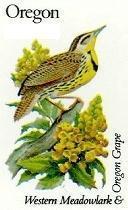
Western Meadolark
(Sturnella neglecta)
Adopted on 1927.
The Western Meadowlark (Sturnella neglecta) was chosen state bird in 1927 by Oregon's school children in a poll sponsored by the Oregon Audobon Society. Native throughout western North America, the bird has brown plumage with buff and black markings. Its underside is bright yellow with a black crescent on the breast; its outer tail feathers are mainly white and are easily visible when it flies. The Western Meadowlark is known for its distinctive and beautiful song.
Meadowlarks are members of the blackbird family. Other blackbird species may have non-black females, but meadowlarks are unique in not having mostly black colors on the male.
The Western's Meadowlarks song is complex, garbled and abrupt. Males commonly use fence posts as perches while singing. They will sing to stake out a breeding territory which averages 7 acres in size but may vary from 3 to 15 acres. The males will have more than one mate. Up to three females may nest within its territory.
Meadowlarks are ground nesters. They weave dried grasses into a bowl shape, typically within a larger grass clump for shelter and camouflage. An average of 5 eggs are laid and they may have two clutches per year. The eggs are white with brown and lavender spots concentrated at the wider end. Incubation takes two weeks and the young are full grown 6 weeks after hatching. The young have some black spots on their breast but do not develop the distinctive black "V" until the fall molt . Nesting and brood-rearing chores are done primarily by the female, although the male may help feed the young.
The majority of their food during the growing season is insects, spiders and other small invertebrates. Some seeds are eaten also, and that becomes the bulk of their food in the winter. During winter meadowlarks will form into flocks of up to a few hundred individuals which are often seen foraging in fields and pastures.
Identification
- Length: 8.5 inches
- Sharply-pointed bill
- Buff and brown head stripes
- Yellow underparts with black "v" on breast
- White flanks with black streaks
- Brown upperparts with black streaks
- Brown tail with white outer tail feathers
- Juvenile and winter plumages somewhat duller
- Frequents open habitats
|
|
| Kingdom |
Animalia -- animals |
| Phylum |
Chordata -- chordates |
| Subphylum |
Vertebrata -- vertebrates |
| Class |
Aves -- birds |
| Order |
Passeriformes -- perching birds |
| Family |
Fringillidae -- buntings, finches, grosbeaks, old world finches, sparrows |
| Genus |
Sturnella Vieillot, 1816 -- meadowlarks |
| Species |
Sturnella neglecta Audubon, 1844 -- Pradero occidental, western meadowlark |